ESELECT_f
Synchronous block Event-Select
Block Screenshot
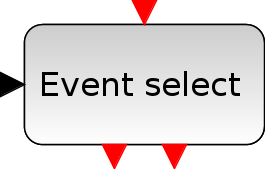
Description
Special block similar to If-Then-Else. Input and output are synchronized. The incoming event is directed to one of the output event ports depending on the value of the regular input.
| Regular input | Output select |
|---|---|
<2 |
Output 1 active (incl. negative input values) |
2 ... <3 |
Output 2 active |
3 ... <4 |
Output 3 active |
| ... | |
(N-2) ... <(N-1) |
Output N-1 active |
>=(N-1) |
Output N active |
For example, when the input value is less then 2, the control input is redirected to the first command output; when the input value is between 2 and 3, the control input is redirected to the second command output; et cætera...
Arguments
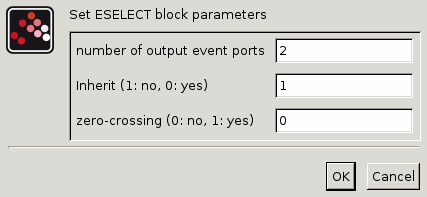
Number of output event ports
A scalar. Number of output event ports.
Properties : Type 'vec' of size 1
Inherit
If no, then it inherits the event from event input port, elseif yes, then event is activated by regular input port.
Properties : Type 'vec' of size 1
Zero-crossing
Select to enable zero crossing detection.
Properties : Type 'vec' of size 1
Default properties
always active: no
direct-feedthrough: yes
zero-crossing: no
mode: no
regular inputs:
- port 1 : size [1,1] / type -1
number/sizes of activation inputs: 1
number/sizes of activation outputs: 2
continuous-time state: no
discrete-time state: no
object discrete-time state: no
name of computational function: eselect
Interfacing function
SCI/modules/scicos_blocks/macros/Branching/ESELECT_f.sci
Examples
Example 1
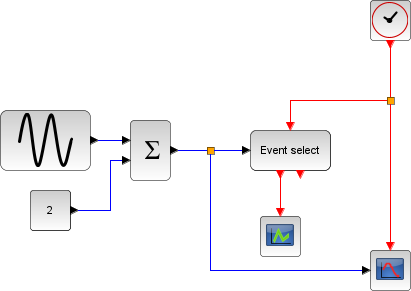
The first event port outputs when the input value is less than 2.
Example 2
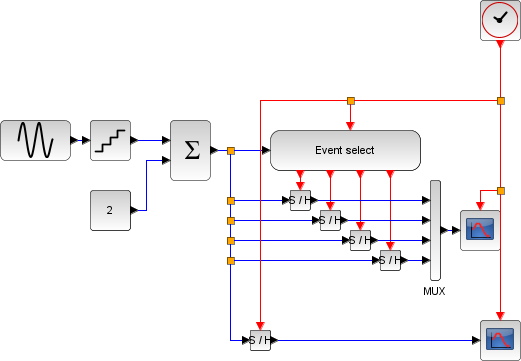
Input values can be categorized using event outputs. This trigger independent data-flow with synchronous execution.
| Report an issue | ||
| << EDGE_TRIGGER | Event handling palette | EVTDLY_c >> |